
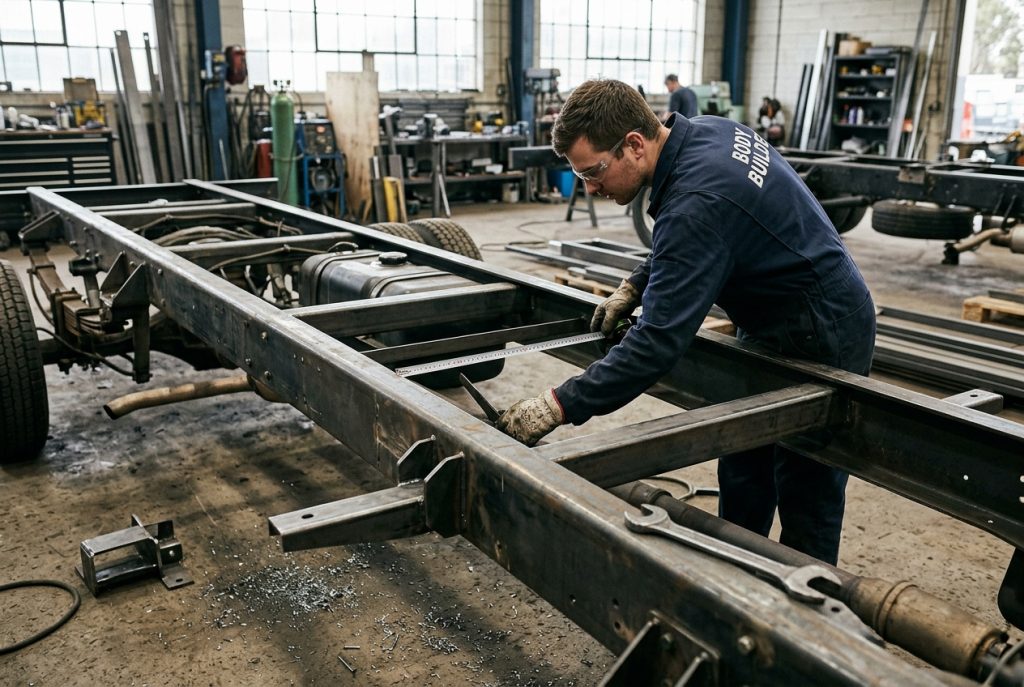
Subframe rail spacing and crossmember layout shape how a truck body connects to the chassis, carries its load and responds to road forces. For a body builder, these dimensions are not merely packaging details: they influence mounting points, frame flexibility and the need for structural reinforcement, all of which affect the durability of the finished vehicle.
Subframe rail spacing and truck body mounting
The distance between subframe rails determines how the body’s weight and operating forces reach the truck frame. It also affects where supports can sit, how the subframe resists twisting and whether the proposed arrangement fits the chassis without interfering with components or existing attachment points.
Rail spacing and load distribution
When the subframe rails sit in a position that corresponds with the chassis rails, the mounting system can transfer loads through a broader, more predictable path. If their spacing is poorly matched, the body may introduce local bending or torsion, especially when its weight is unevenly distributed or the truck travels over rough ground.
Subframe supports and frame flexibility
A truck frame flexes as its axles move over uneven surfaces. The subframe and its attachments must accommodate that movement rather than restrain the chassis so rigidly that stress builds around bolts, brackets or rail flanges.
Crossmember layout and structural reinforcement
Crossmembers connect the chassis rails and help the frame resist twisting and lateral movement. Their position and design influence where a body can be supported, so the crossmember layout should be considered alongside the subframe rather than treated as a separate fabrication detail.
Crossmember positions and body support
Supports placed near suitable crossmembers can provide a direct path for forces into the frame structure. However, a body builder must check the actual locations and permitted attachment zones: moving or adding a crossmember without assessing the complete frame can alter stiffness and affect how loads travel through the chassis.
Mounting points and attachment methods
Mounting points should be selected to suit both the body and the frame, with attention to fastener type, bracket geometry and the way forces act during braking and cornering. Where U-bolts are used, body-builder guidance may require rear stops on each frame side member to restrain the body and reduce undue stress on the fasteners during a sudden stop.
The relationship between rail spacing, crossmember positions and attachments can be summarized as follows. The table is a planning aid, not a substitute for the truck manufacturer’s instructions.
| Design factor | Effect on mounting | Key verification |
|---|---|---|
| Subframe rail spacing | Influences support width and load transfer into the chassis | Confirm alignment with the frame and body geometry |
| Crossmember layout | Shapes frame stiffness and available support locations | Check approved positions and any limits on modification |
| Attachment method | Determines how forces pass between body and frame | Follow specified fasteners, brackets and restraint details |
| Body load distribution | Affects axle loading, balance and local frame stresses | Verify axle capacities and the loaded vehicle configuration |
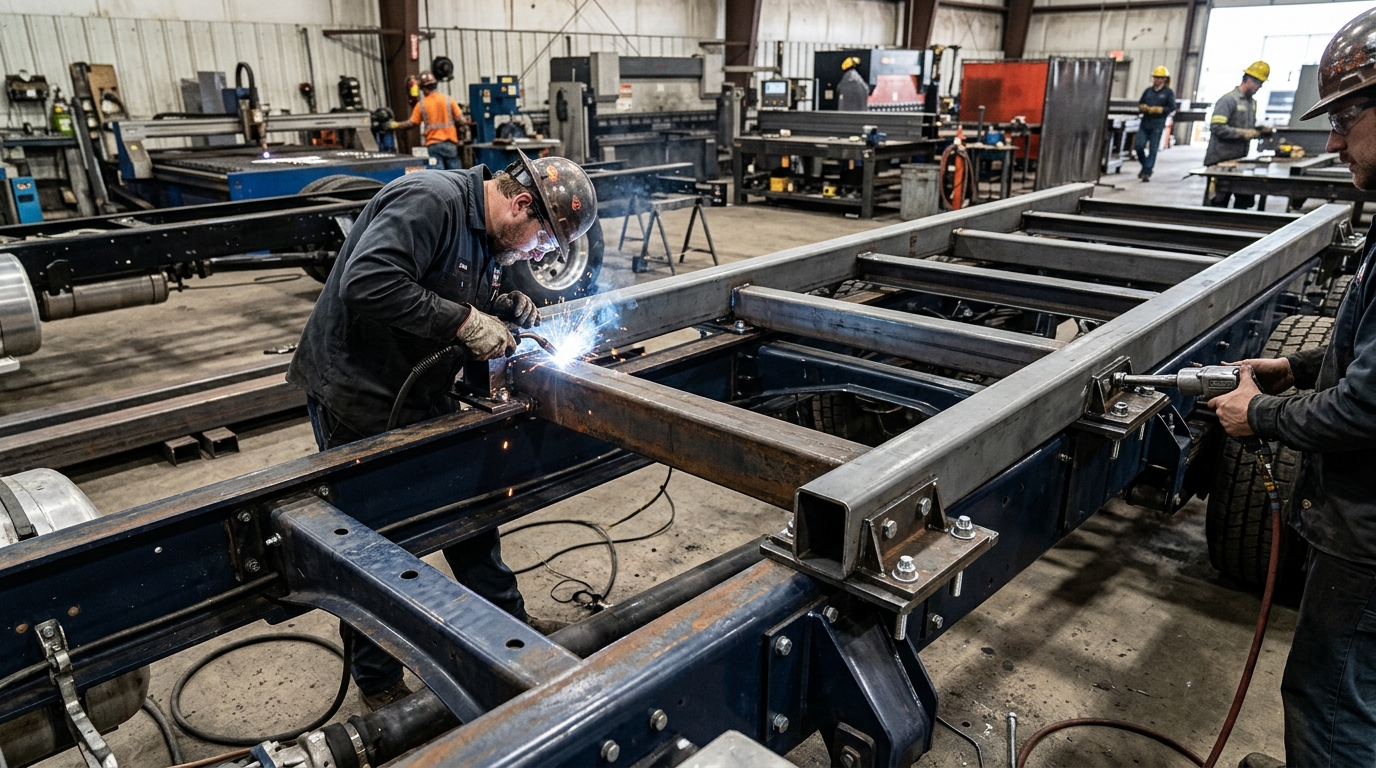
Body builder design and frame behaviour
A mounting design must support the body while respecting the chassis’s structural role. This means considering frame flexibility, load distribution and attachment details as one system, particularly when a body is heavy, tall or exposed to changing loads during operation.
Frame movement and reinforcement choices
Structural reinforcement may be appropriate where the approved design identifies a need, but adding material indiscriminately can make one area too rigid and shift stress elsewhere. The goal is not to eliminate frame movement; it is to provide adequate support while allowing the chassis to behave as intended.
Truck body installation and final checks
Before truck body installation, the builder should compare the proposed mounting scheme with the manufacturer’s body-builder instructions and confirm that clearances, attachment locations and operating loads are compatible. After modifications or body fitment, axle alignment should be checked and corrected where necessary, as chassis work can affect it.
A practical review should cover the following points before the vehicle enters service:
- Confirm that the subframe dimensions and mounting points match the approved chassis configuration.
- Check that the crossmember layout supports the intended body without unapproved frame alterations.
- Verify axle loads, centre-of-gravity position and load distribution in the operating condition.
- Inspect fasteners, restraints and clearances, then confirm axle alignment after installation.
Because chassis designs and body duties vary, a qualified body builder or vehicle engineer should review the proposed installation and resolve any uncertainty against the applicable manufacturer documentation. That specialist assessment helps ensure the finished truck is suited to its intended work.